What it estimates
Three physically different sensing channels feed an on-device model. No liquid reagents, a few watts of power, and readings on a fixed, unattended schedule.
Every estimate comes with an uncertainty range, and the sensor flags readings it should not be trusted on, such as a fouled sensor or water unlike anything it was validated on, instead of reporting a confident wrong number. Microbial signals are early warning only, not a substitute for lab microbiology. There is no turbidity channel yet.
Why field trials
The models that turn the sensor's signals into estimates have to be trained and checked on real water. We place one sensor node beside an existing monitoring station or sampling point for a season or more. The node takes readings on its own schedule, typically every 15 to 30 minutes. Each time the host takes its routine lab sample, we line that result up with the node's reading from the same time. Over months, those pairs show where the estimates hold up and where they miss, and they train the models that make the estimates.
How a site is set up
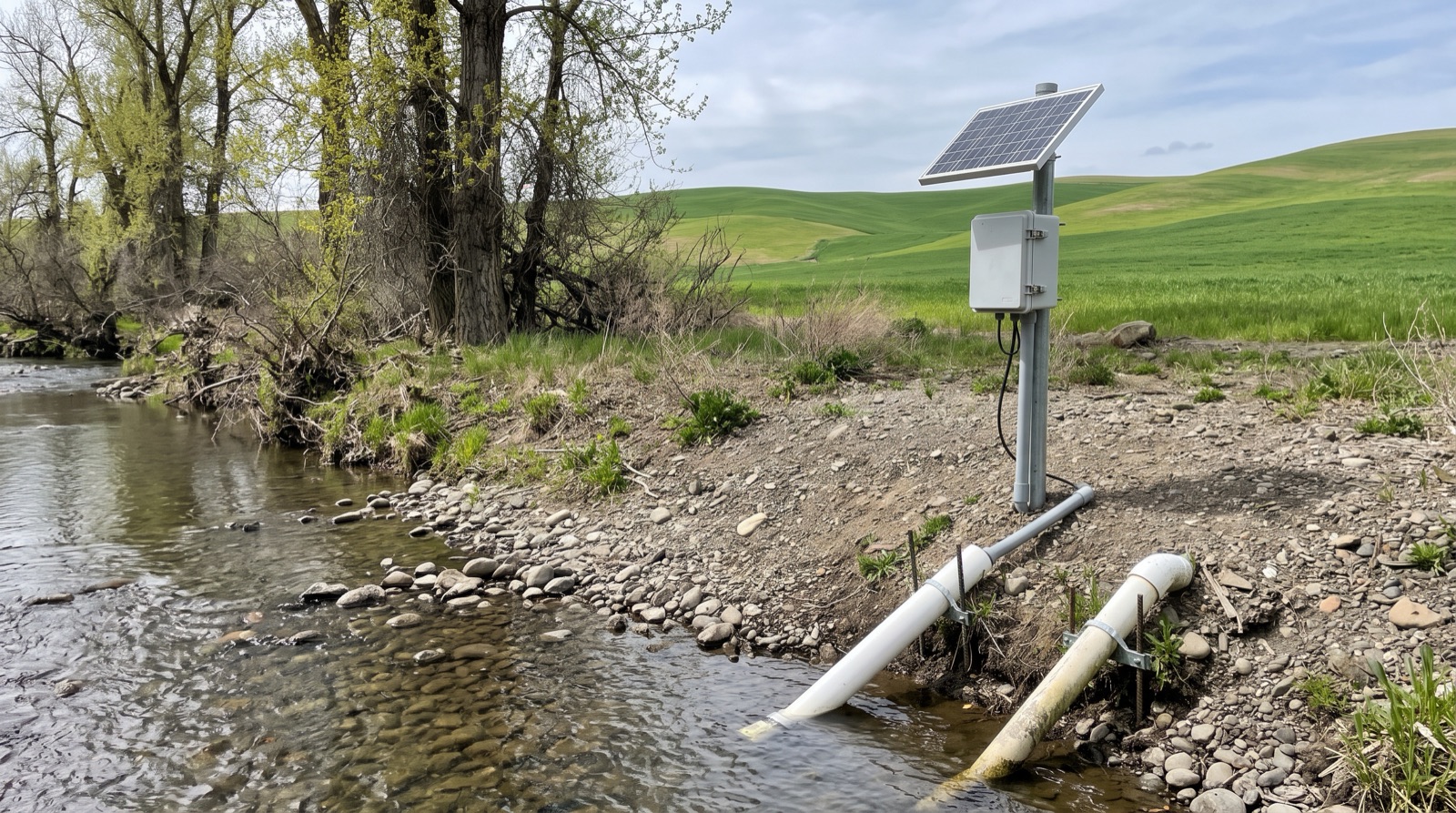
The node is self-contained. It does not connect to the host's instruments, data logger or data stream.
What gets installed
| Item | What it is | Where it goes |
|---|---|---|
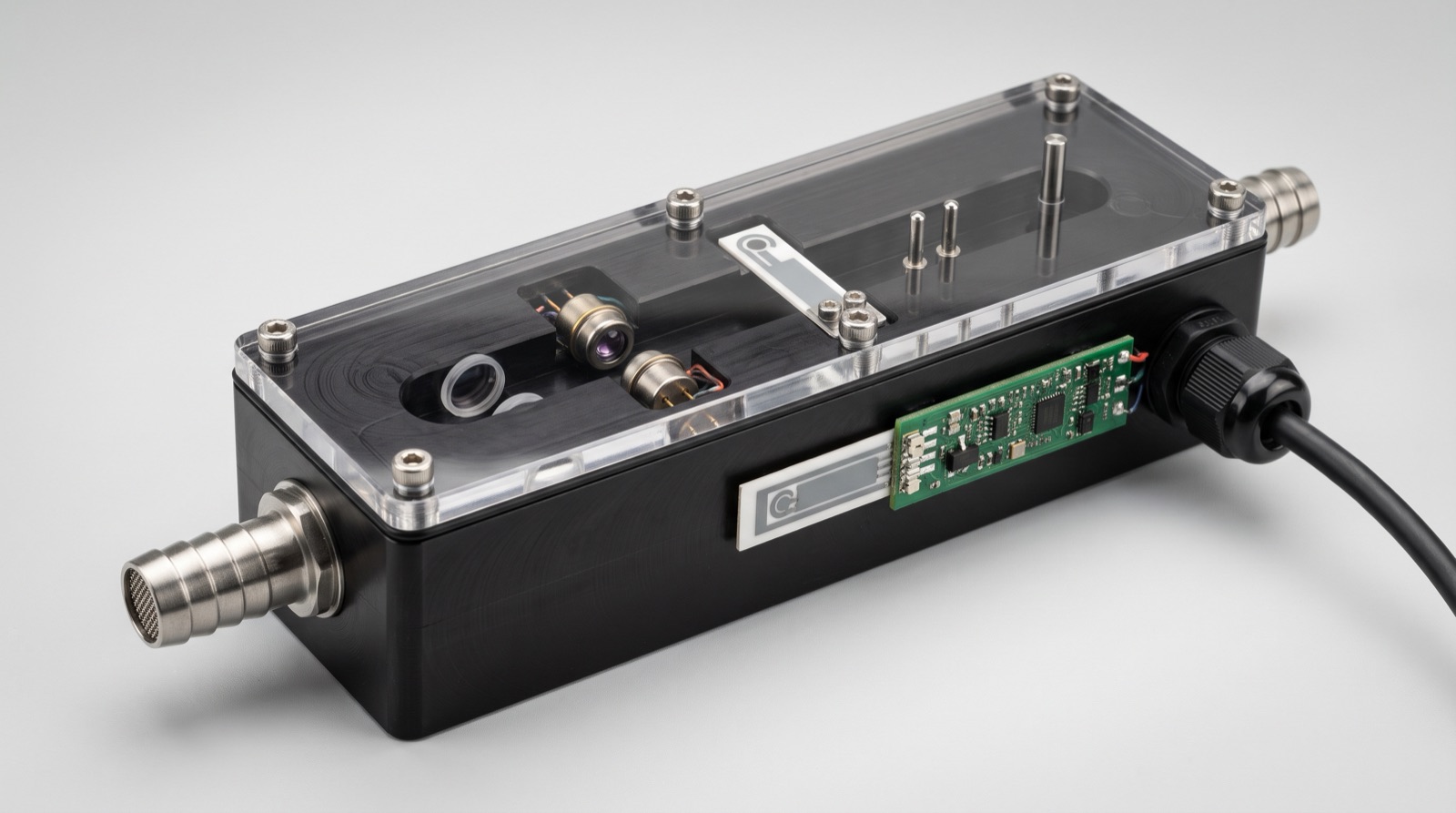
| Sensor head | A flow-through block about 10 × 3 × 3 inches (25 × 8 × 8 cm) carrying three sensing channels | In the water beside the existing probe, in its own deployment pipe, or on a tap or bypass line at a treatment site |
| Enclosure | A small weatherproof box with the edge computer that runs the model at the site, a cellular modem and the battery or power supply | On its own post or bracket, wherever the host prefers |
| Power | A few watts. A small solar panel and battery, or spare station power if the host offers it | On the same post |
| Data link | The node's own cellular modem. Nothing connects to the host's logger or telemetry | In the enclosure |
| Cabling | One sensor cable from the water to the enclosure, plus a power lead, in protective conduit | Routed and secured only where the host allows |
Three sensing channels
- Deep-UV absorbance and fluorescence: nitrate and organic load
- Stripping voltammetry: heavy-metal signatures
- Impedance spectroscopy: conductivity and salinity
An on-device model combines the channels. Every estimate carries an uncertainty range, and the node flags readings it should not be trusted on, such as a fouled window or water unlike anything it was validated on.
Fluorescence gives early warning of microbial load only; it is not a substitute for laboratory microbiology. The node does not yet have a turbidity channel.
How the readings are checked
Every routine sample the host already takes becomes a reference point. Where a site has no lab program, samples go to an accredited laboratory.
| Sensor estimate | Compared with |
|---|---|
| Nitrate | Lab nitrate + nitrite as N (EPA 353.2) |
| Organic load | COD (EPA 410.4) and TOC/DOC (SM 5310); BOD5 at treatment and wastewater sites |
| Conductivity / salinity | Specific conductance (SM 2510) and TDS |
| Heavy-metal signatures | Dissolved metals by ICP-MS (EPA 200.8) |
Each sample is matched to the sensor reading from the same time, with field duplicates and blanks for quality control. The host gets the full comparison, including where the estimates miss.
A trial, step by step
- Before installSite walk and agreement. We confirm the spot, power, access and any paperwork the host needs, such as a written agreement or an insurance certificate.
- Spring 2027Install. One visit: post, enclosure, cable and sensor head. The host's equipment is not touched.
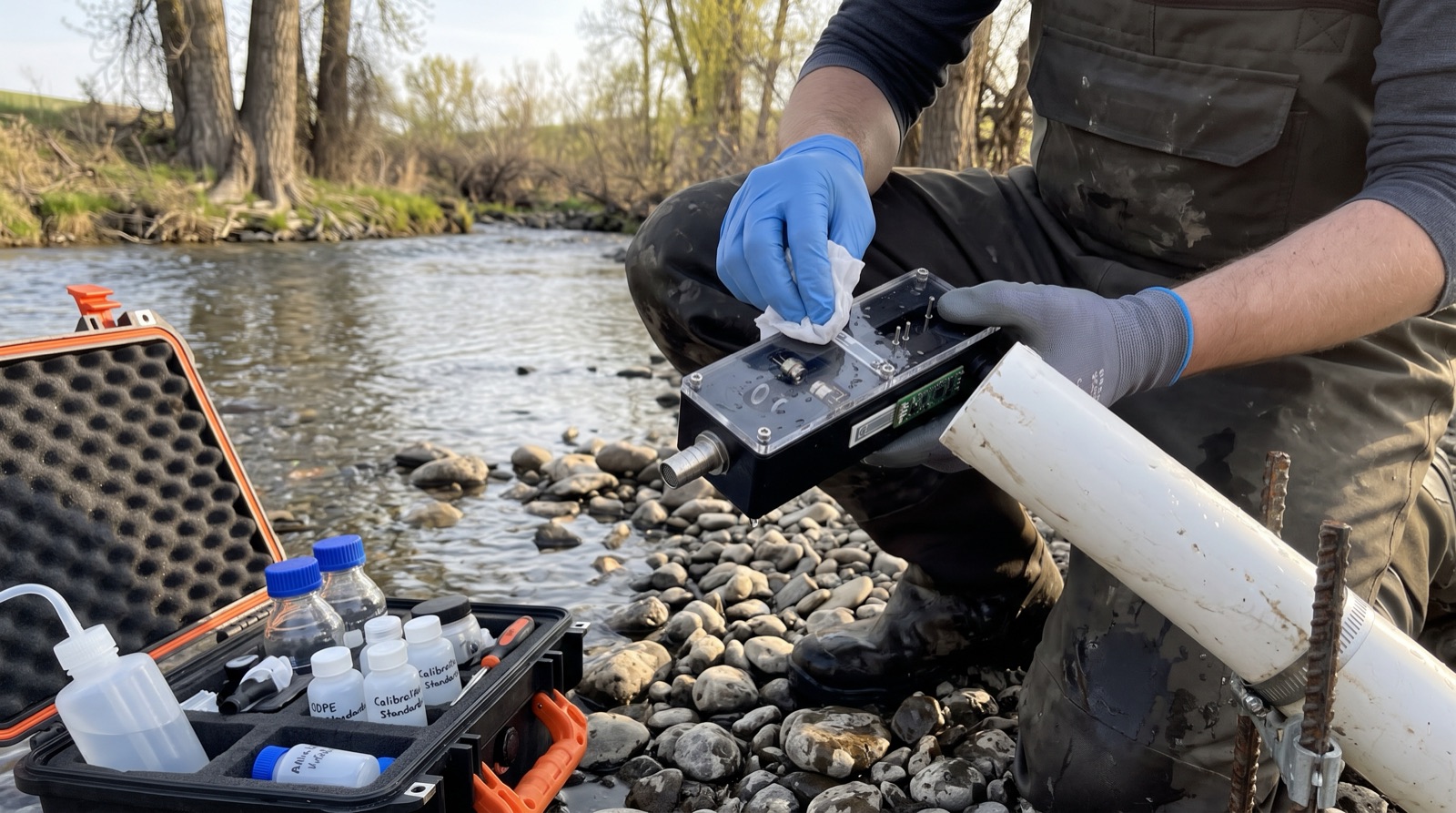
- Every 4–6 weeksService visit. Clean the optical window and electrodes, check each channel against standards, take a reading before and after cleaning, and pull data. Wastewater sites start at every 1–2 weeks.
- Each lab samplePair the data. The host's routine result is matched with the node's reading from the same time.
- WinterFreeze plan. We protect the sensor head from ice or pull the unit until spring.
- End of trialReport. The host receives the full comparison. The node stays on a data plan or we remove it at no cost.
Sponsor a field site
Want a node at your own well, irrigation source or treatment outflow, with reports included? A sponsorship is a purchase of a field-pilot service from Tolman Solutions LLC, not a donation.
Site Sponsor
- One sensor node installed at your site
- 6 months of readings
- Dashboard access to your site's readings and alerts
- Quarterly reports, plus the final field report
- Your name on our sponsor list (optional)
Validation Sponsor
- One sensor node installed at your site
- 12 months of readings
- Up to 12 accredited lab reference samples from your site, compared with the sensor's estimates
- Dashboard access, quarterly reports and the final field report
- Your name on our sponsor list (optional)
Secure checkout by Stripe. Full refund if your node is not installed by June 30, 2027. Full terms.
What a host provides, and what we cover
The host
- Room for the sensor head near the water and a post for the enclosure
- Permission to install, and help with any landowner or right-of-way access
- Routine lab results for the site, with sample times, where they exist
- Any requirements of its own: agreement, insurance certificate, notice before visits
Tolman Solutions
- The node, install and all maintenance, at our cost
- Reference lab testing where the site has none
- Readings kept outside the host's QA program and data systems
- The full comparison report; the host's site data stays the host's
Host a trial
We are looking for a small number of monitoring stations, farms, wineries and treatment sites for 2027. If you run one and want to see how a low-cost sensor compares with your own lab results, get in touch.